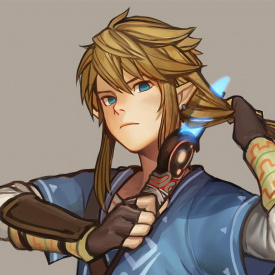
"'Brandywine'?" Gwainedhel misspelled, having his brain either heard wrong or distorted the message through bias. "Like the river in the Lord of the Rings? Brandywine?"
Brandywine, Braddwynne... Certainly, when Ru went up and called him 'Brad' upon meeting, Gwainedhel surmised that it may actually the first, nor the second. But for some reason Gwainedhel's brain didn't feel too cooperative at the time. Being surrounded by nobles in that hard and pressing atmosphere made him the utmost comfortable, and that definitely played a toll on his already precarious ability to remember names. So, unless he had to save face for some social reason, he would label the poor blonde guy in his head like he had: Mister
Brandywine.
So, with some chitchat made and motives of the forecoming storyline put on the table, a rather formal steward came to their encounter and escorted them to the inner chambers, where the progenie of the falling noble laid. What they found was an almost cartoonish bickering between three siblings: Klaus, Ilse and Friedrich, as Gwainedhel later learned. The steward himself was Hans. And with that, and Schweiss being the name of the former family, the elf couldn't help but to send a deprecating message to the screenwriters of the game, as though they could see his inner rolling eyes. <i>"My gosh, why do all the cold uptight nobles in power family intrigues intrigues have to be
German?"</i>. I mean, he gets it, there's the whole Sacred Roman Empire and all that jazz, but-- Hey, he missed some old Spanish representation, you know? Doña Elvira, don Fernando, don Álvaro...
Except, when Gwainedhel found himself there, standing in the middle of the conversation, an uncanny, sucking sensation spinned him out of his mind.
Klaus, Ilse, Friedrich. He
felt them. Underneath what meets the eye, he could feel three, very distinct souls that burned with very identifiable feelings that penetrated right to the elven heart. Gwainedhel had not yet unlocked the racial traits that would allow him to identify with more precision the specific nature of those feelings, so he surmised that everything that he was perceiving was a projecting product of his real-life experiences.
To outsider eyes, he could see Klaus, Ilse and Friedrich as
vultures. Then, he looked down at himself, and
he was the vulture.
A vulture with a pretty face, long red hair, a darling yellow dress and a radiant smile.
Because, we have to remember, Gwainedhel was actually a pretty different person in real life. In reality, he was Alejandra García Villena, the sole daughter of one of the most affluent families in the County of Barcelona.
Surely, being the only heir, she hadn't any siblings to bicker with, but she couldn’t swear that he would have behaved differently, were she in their shoes.
Klaus, since he was the eldest of the family, represented the kind of person she used to be when she first logged into Terrasphere. Being the eldest, he had possibly been placed into an unhealthy amount of pressure, moreso as the firstborn male of a patrilineal system that invested status on these ranks to thrive. Alejandra could picture him not being intrinsically valued for himself as a person, but rather for his willingness to perform to an unending set of draconian standards under the threat of not being treated like a person otherwise The result? A packed, turbulent ball of fury that grows a narcissistic persona to deal with his lot in life.
Going next to Ilse, Alejandra could see in her the pressure that she had herself been given: manners. Be good, Alejandra; nice, Alejandra, nice-good-nice-good-nice-good–
Ugh! Could nobody see, that this was a similar torture than what Klaus went through, but from the other side of the fence? She’s the middle one, and a woman to a boot, so she doesn’t really have as much access to political power as her brother. But she still has another kind of pressure to live up for, and that’s the will to become a wife. She had to be nice to come as agreeable to people and have them give her what they want; she had to be good, to not be pointed at as a wretched witch and find her head on a spike. There are those who say that, if the system was matrilineal she wouldn’t have to deal with such a burden, but to Alejandra it hardly made any difference: one gender dehumanizes you to become an object of success, another dehumanizes you for becoming a sexual object. Alejandra wouldn’t hold Ilse’s resentment towards the father against her if all she saw in him was this neglectful, authoritative figure of power that attempted to restrict her liberties.
Last, but not least, there was the young Friedrich, who reminded Alejandra of who would she become in life: a calculating fellow that, very likely, would harbor within himself Klaus’ unbridled anger, but was able to stifle it with the garnished manners that Ilse was taught to abide. She would have likely chuckled if she knew that she was the second-in-command to administrate the family’s wealth:, too, for Alejandra herself was going to a Laws & Business school to manage her own patrimony in real life.
In sum, the three nobles kind of reminded Alejandra and Gwainedhel of Dickens’ Christmas Carol: Klaus was the Vulture of Christmas Past, Ilse the Vulture of Christmas Present, and Friedrich (unless she did a dramatic psychological spin before she finished school), the Vulture of Christmas Future. Alright, folks! Gwainedhel, the most empathetic bastard of the trio, is here to treat you like people!
It must be for all these reasons explained above, that when Bandywine -Bradwynne, sorry– spoke of a lesson about compassion, a pang of anger kicked Gwainedhel in the gut. The elf didn’t think that the polite blonde man was neither ill-intended nor wrong, by any means, but he took his impression on the three nobles so personally, that he couldn’t simply treat this as a situation of father = good, children = evil.
"You want my opinion? I'd prescribe your goods to the person that aligns the best with your values and arm them with counsel and protection should your failed heirs go after their gut. As for the lesson of compassion, I'd agree there, too, but do it in a way that shows compassion yourself. Chicklings don't become vultures in the vacuum, and even vultures have a reason to eat carrion themselves. You know, there's always... circumstances."
With Gwainedhel’s poignant comment, the noble seemed to grit his teeth in the bed, and he added after some labor:
“What are you saying, you bitter young man? Are you... Are you blaming me for the ingratitude of my children?!”
“No, sir - or, at least, not completely. What they are doing to you is downright despicable and I personally wouldn’t like to get near them with a touch-pole. I wouldn't even forgive them, if you don't have the heart for it. What I am saying, though, is that us people are complicated and multiple circumstances can turn us into unsavory. On the same line, a ray of light can snap us off our ways, make us look into the mirror and even steer us to redemption's path. If you are going to go with this lesson of compassion, I’d say you do it with a pinch of grace, specially if you feel you had any bearing in your children's path.”
The bed-ridden noble squinted at Gwainedhel and grinded his teeth as he was thinking whether to say. To Gwainedhel’s mind, it would seem that the noble was regarding him as the same leech as them. So, the elf decided to say nothing, and he gave a sullen nod at the casting
@Bradwynne and the composed @Ru Nuang as he sat on a stool in the shadow.
[OOC: No problem-- Whah, you made me write quite a long post! Sorry for the psychological intensity of this one. As a summary, Gwainedhel does sympathize with the nobles' children and he takes a very savoury stance.]